
Start-Up India Registration in India
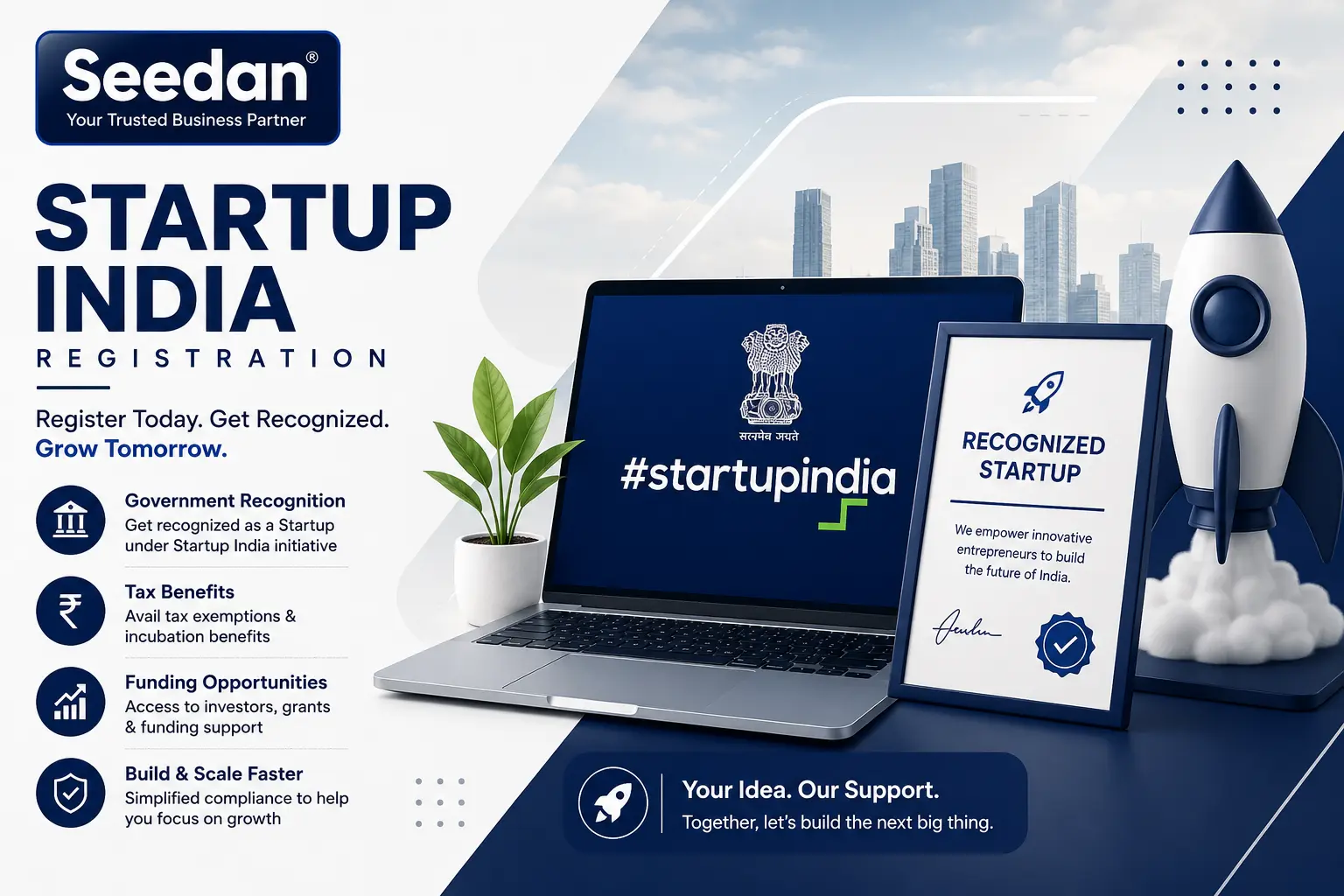
Start-Up India Registration (formally DPIIT Recognition) is a government initiative that grants eligible new-age businesses startup status, unlocking benefits including income tax exemption for 3 years, easier compliance, IPR fast-tracking, and access to government funding schemes. Eligibility requires the entity to be incorporated as a Private Limited Company, LLP, or Partnership Firm, be under 10 years old, and have annual turnover under ₹100 crore. Registration is done online via the Startup India portal.
What Is Start-Up India Registration?
Start-Up India Registration, officially known as DPIIT Recognition (Department for Promotion of Industry and Internal Trade), is a status granted to eligible businesses under the Government of India's Startup India initiative. It's not a separate legal entity type — it's a recognition layered on top of an existing Private Limited Company, LLP, or Partnership Firm that meets specific innovation and scalability criteria.
To qualify, the entity must be working toward innovation, development, or improvement of products/services, or have a scalable business model with high potential for employment or wealth creation — not merely a routine business activity. Recognized startups gain access to income tax exemption under Section 80-IAC (for 3 consecutive years out of the first 10), exemption from angel tax, self-certification for labour/environmental laws, easier public procurement norms, and faster trademark/patent processing at reduced fees.
Documents & Eligibility Required
Step-by-Step Process
- 1Confirm eligibility — entity type, age under 10 years, turnover under ₹100 crore, and genuine innovation/scalability focus.
- 2Incorporate the business as a Private Limited Company, LLP, or Partnership Firm, if not already done.
- 3Register on the Startup India portal with entity and founder details.
- 4Submit the DPIIT recognition application, including a brief write-up on the business's innovative/scalable nature.
- 5Upload supporting documents — incorporation certificate, PAN, business description.
- 6Application reviewed by DPIIT; clarifications may be requested.
- 7Receive DPIIT Recognition Certificate, unlocking eligibility for tax exemption and other startup benefits.
Start-Up India Recognition vs Related Registrations
Frequently Asked Questions
Businesses formed by splitting up or reconstructing an already existing business, or those not focused on innovation, development of new products/services, or a scalable business model, are generally not eligible for DPIIT recognition.
Recognized startups can apply for income tax exemption under Section 80-IAC for 3 consecutive years within their first 10 years of incorporation, and are also eligible for exemption from angel tax on investments received, subject to conditions.
No, only entities registered as a Private Limited Company, Limited Liability Partnership, or Partnership Firm are eligible for DPIIT Startup Recognition — proprietorships and OPCs are not eligible under current criteria.
DPIIT recognition remains valid for up to 10 years from the date of incorporation, or until the entity's turnover exceeds ₹100 crore in any financial year, whichever is earlier. ---
Ready to get DPIIT Startup Recognition?
Eligibility assessment, application drafting & filing in one package.
⭐ 4.9/5 rated • CA/CS Assisted
Reviewed by our compliance team
CA/CS Panel, Seedan Group
This guide is reviewed by practicing Chartered Accountants and Company Secretaries at Seedan Group with hands-on experience in Indian business registration and compliance. Content is for general guidance and updated as regulations change.
Related Services
Other services our clients often pair with this one.
Digital Signature (DSC)
A Digital Signature Certificate (DSC) is a government-recognized electronic equivalent of a physical signature, used to sign documents and filings digitally o
Learn moreDrug License
A Drug License is a mandatory authorization issued under the Drugs and Cosmetics Act, 1940, required by any business involved in the manufacture, sale, storag
Learn moreESI Registration
ESI (Employees' State Insurance) Registration is mandatory under the ESI Act, 1948, for establishments employing 10 or more employees (in most states) whose m
Learn moreFSSAI Basic Registration
FSSAI Basic Registration is the entry-level food safety authorization under the Food Safety and Standards Authority of India, mandatory for food businesses wi
Learn more