
Section 8 Company Registration in India
A Section 8 Company is a non-profit entity registered under Section 8 of the Companies Act, 2013, formed to promote charitable objectives such as education, social welfare, art, science, or environmental protection — with all profits reinvested into the entity's objectives rather than distributed to members. It requires a minimum of 2 directors and no minimum capital, and offers greater credibility and easier access to institutional/CSR funding than a Trust or Society. Registration is done through the MCA's SPICe+ form.
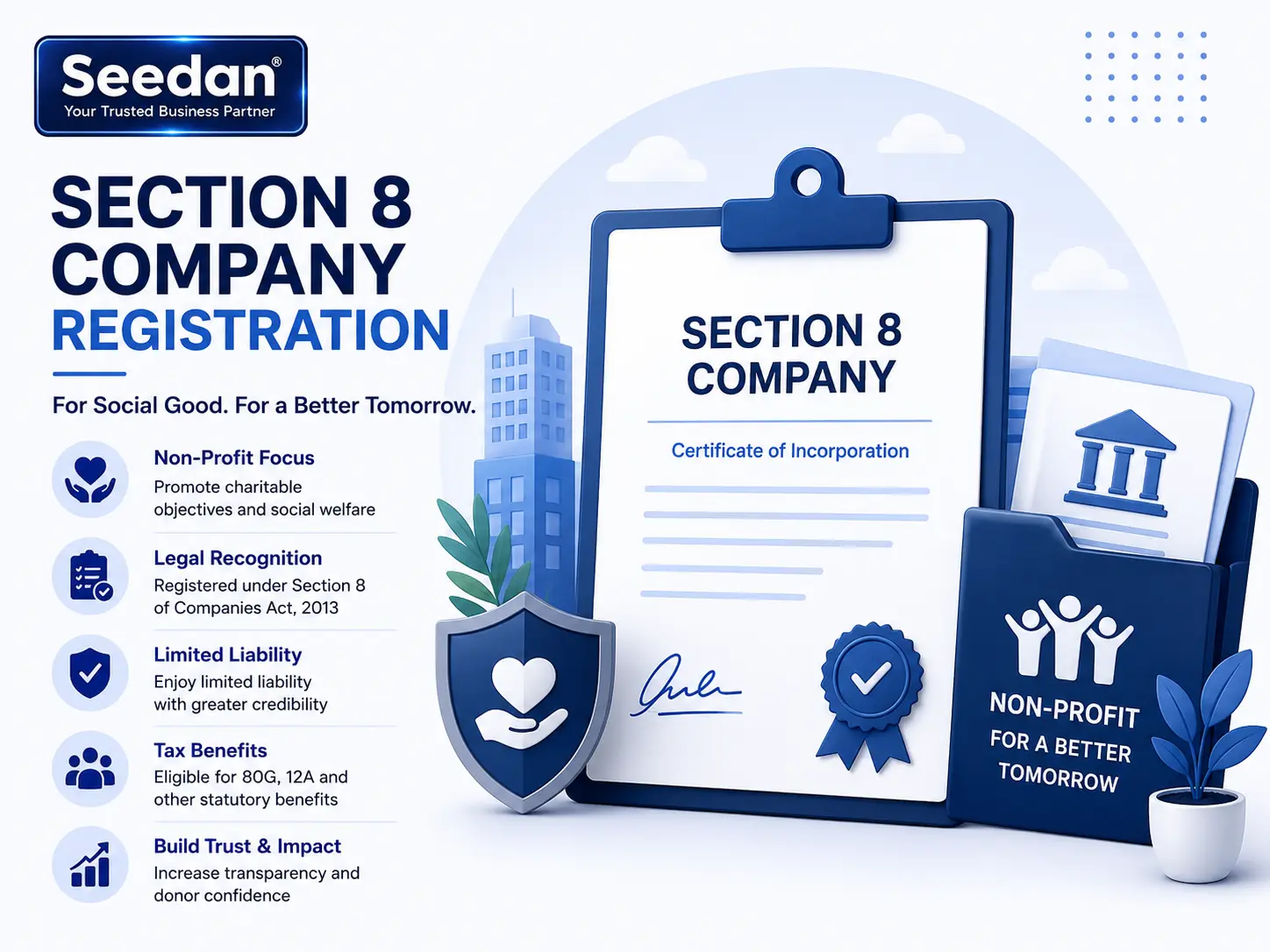
What Is a Section 8 Company?
A Section 8 Company is a company formed for promoting charitable, non-profit objectives — including education, social welfare, sports, science, religion, art, and environmental protection — without the intent to distribute profit to its members. Unlike a private limited company, a Section 8 Company cannot pay dividends; all income must go back into furthering the entity's stated objectives.
It carries a separate legal identity, limited liability for its members, and is widely regarded as the most credible non-profit structure among Trusts, Societies, and Section 8 Companies — particularly with corporate CSR funders, government grant bodies, and international donors, because it follows the same rigorous MCA governance and disclosure norms as a Private Limited Company.
A Section 8 Company does not need the word "Limited" or "Private Limited" in its name, and instead typically includes words like "Foundation," "Association," "Council," or "Federation."
Registrations & Documents Required
Step-by-Step Process to Register a Section 8 Company
- 1Obtain Digital Signature Certificate (DSC) for all proposed directors.
- 2Reserve a company name via the MCA's Part A of SPICe+ — must reflect the charitable purpose and avoid restricted words.
- 3Draft MOA (Form INC-13) and AOA — clearly stating the charitable objectives and the "no profit distribution" clause.
- 4Apply for Section 8 License (Form INC-12) — submitted to the Registrar of Companies with objectives, projected financials, and a declaration of non-profit intent.
- 5File SPICe+ (Part B) — the integrated incorporation form, filed once the Section 8 license is approved.
- 6Receive Certificate of Incorporation from the ROC, along with company PAN and TAN.
- 7Apply for 12A and 80G registration with the Income Tax Department to unlock tax exemptions and donor tax benefits.
Section 8 Company vs Other Non-Profit Structures
Frequently Asked Questions
Yes, a Section 8 Company can generate profit through its activities, but that profit cannot be distributed to members as dividends — it must be reinvested entirely into furthering the company's charitable objectives.
No, 12A and 80G registration are not mandatory for incorporation, but they are separate registrations under the Income Tax Act that a Section 8 Company should apply for afterward to obtain income tax exemption (12A) and to allow donors to claim tax deductions on their contributions (80G).
"NGO" is a broad, informal term for any non-governmental, non-profit organization — a Section 8 Company, Trust, and Society are all legally recognized structures that fall under the broader category of NGOs, with Section 8 being the most formally regulated of the three.
Direct conversion into a for-profit Private Limited Company is not straightforward under the Companies Act, given the non-profit objectives a Section 8 Company is registered to pursue. Converting out of Section 8 status requires regulatory approval from the Central Government and is uncommon in practice.
A Section 8 Company requires a minimum of 2 directors for a private Section 8 Company, or 3 directors if it is registered as a public Section 8 Company, with no upper limit on the maximum number of directors.
No. Unlike other companies, a Section 8 Company is exempted from including "Limited" or "Private Limited" in its name, and instead commonly uses terms like Foundation, Federation, Council, Chambers, or Association. ---
Ready to register your Section 8 Company?
Section 8 license, SPICe+ filing, MOA/AOA drafting & 12A/80G guidance in one package.
⭐ 4.9/5 rated • CA/CS Assisted
Reviewed by our compliance team
CA/CS Panel, Seedan Group
This guide is reviewed by practicing Chartered Accountants and Company Secretaries at Seedan Group with hands-on experience in Indian business registration and compliance. Content is for general guidance and updated as regulations change.
Related Services
Other services our clients often pair with this one.
12A & 80G Registration
12A and 80G are two separate registrations under the Income Tax Act, 1961, available to NGOs, Trusts, and Section 8 Companies. 12A registration exempts the or
Learn moreLLP Registration
A Limited Liability Partnership (LLP) is a business structure governed by the LLP Act, 2008 that combines the operational flexibility of a partnership with th
Learn moreOne Person Company
A One Person Company (OPC) is a company structure introduced under the Companies Act, 2013 that allows a single individual to own and run a company with limit
Learn morePartnership Firm
A partnership firm is a business owned by two or more individuals who agree to share profits and losses under a Partnership Deed, governed by the Indian Partn
Learn more