
Proprietorship Compliance in India
Proprietorship Compliance covers the ongoing obligations a sole proprietorship must meet after registration — primarily annual income tax return filing (ITR-3 or ITR-4) under the proprietor's own PAN, GST return filing (if GST-registered), and renewal of registrations like Shop & Establishment, Udyam, or FSSAI where applicable. As the simplest business structure, proprietorship compliance is the lightest among all entity types, with no ROC or Registrar filings at all.
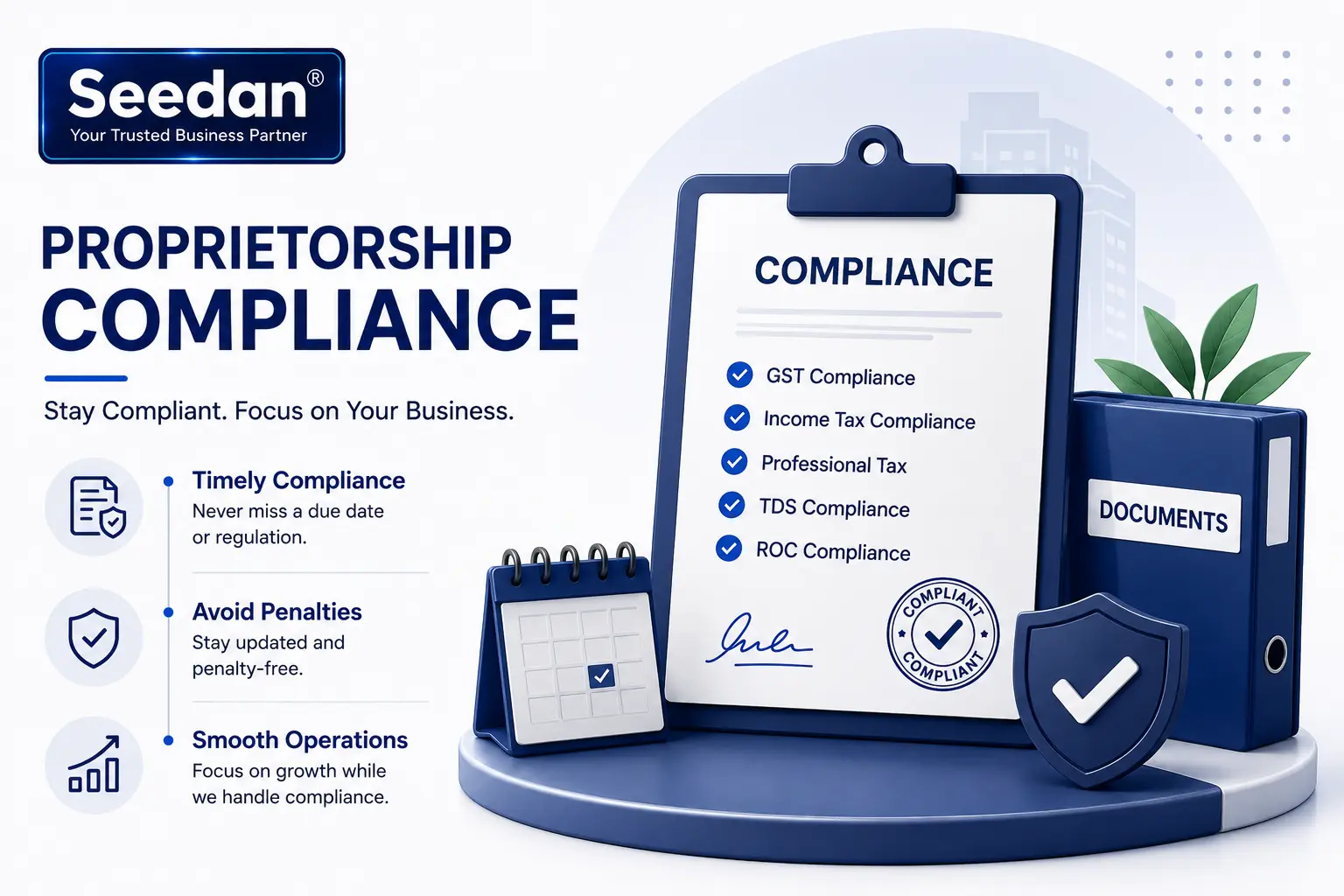
What Does Proprietorship Compliance Cover?
A proprietorship, having no separate legal identity from its owner, has the lightest compliance burden of any Indian business structure — there's no annual return to file with the Ministry of Corporate Affairs or Registrar of Firms, since the business isn't a separate registered entity in that sense. The core ongoing obligation is the proprietor's own income tax return, reporting business income alongside any personal income, using ITR-3 (regular scheme) or ITR-4 (presumptive taxation, if eligible).
Beyond tax filing, ongoing compliance also includes renewing any registrations obtained at setup — Shop & Establishment License, FSSAI (if a food business), Trade License — each on its own validity cycle, plus GST return filing if the proprietorship is GST-registered, and payroll compliance (PF/ESI/Professional Tax) if the business has employees crossing applicable thresholds.
Proprietorship Annual Compliance Checklist
Step-by-Step Process to Stay Compliant
- 1Maintain accurate business records throughout the year — income, expenses, and relevant supporting documents.
- 2Track registration renewal deadlines — Shop & Establishment, FSSAI, Trade License, and any other licenses obtained.
- 3File periodic GST returns (if registered), reconciling monthly/quarterly.
- 4File quarterly TDS returns, if the business deducts tax at source on any payments.
- 5Determine if a tax audit is required, based on turnover thresholds and presumptive taxation eligibility.
- 6File the annual ITR (ITR-3 or ITR-4), incorporating business income alongside any personal income.
- 7Renew Udyam Registration details if business figures (turnover/investment) have materially changed, to keep MSME classification accurate.
Proprietorship Compliance vs Related Entity Compliance
Frequently Asked Questions
No, since a proprietorship has no separate legal identity and isn't registered with the MCA or Registrar of Firms, there's no annual ROC-equivalent filing — the primary recurring compliance is the proprietor's own income tax return.
This depends on whether the proprietorship opts for presumptive taxation — ITR-4 (Sugam) applies if eligible and opted into Section 44AD/44ADA, offering simplified compliance without requiring detailed books of accounts, while ITR-3 applies under the regular scheme with full books of accounts.
Depending on what was obtained at setup, a proprietorship may need to renew its Shop & Establishment License, FSSAI Registration/License (if a food business), and Trade License — each has its own validity period and renewal deadline, separate from tax filing deadlines.
No, a tax audit is required only if turnover or gross receipts exceed the prescribed threshold, or if the proprietorship declares income below the presumptive rate while otherwise eligible for the presumptive scheme — below these triggers, no audit is needed.
No, GST registration and its associated compliance obligations apply only once turnover crosses the applicable threshold, or if the proprietorship falls under a mandatory registration category (such as e-commerce sellers) regardless of turnover. ---
Ready for full Proprietorship compliance support?
Bookkeeping, tax filings & renewals in one package.
⭐ 4.9/5 rated • CA/CS Assisted
Reviewed by our compliance team
CA/CS Panel, Seedan Group
This guide is reviewed by practicing Chartered Accountants and Company Secretaries at Seedan Group with hands-on experience in Indian business registration and compliance. Content is for general guidance and updated as regulations change.
Related Services
Other services our clients often pair with this one.
Bookkeeping & Accounting
Bookkeeping & Accounting Services cover the systematic recording, organizing, and reconciling of a business's financial transactions — sales, purchases, expen
Learn moreBusiness Plan Preparation
A Business Plan is a structured document outlining a business's objectives, market analysis, operational model, and financial projections — required for bank
Learn moreESI Return Filing
ESI Return Filing is the monthly submission of employee contribution details to the ESIC, reporting wages and the corresponding ESI contribution (employer and
Learn moreFSSAI Renewal
FSSAI Renewal is the process of extending an existing FSSAI Registration or License before its validity period expires, required to avoid disruption to food b
Learn more