
Private Limited Company Compliance in India
Private Limited Company Compliance covers the mandatory annual obligations under the Companies Act, 2013 — including Form AOC-4 (financial statements), Form MGT-7 (annual return), a mandatory statutory audit regardless of turnover, and income tax return filing (ITR-6). It's the most compliance-intensive of India's common business structures, also requiring a minimum number of board meetings each year and ongoing ROC disclosures.
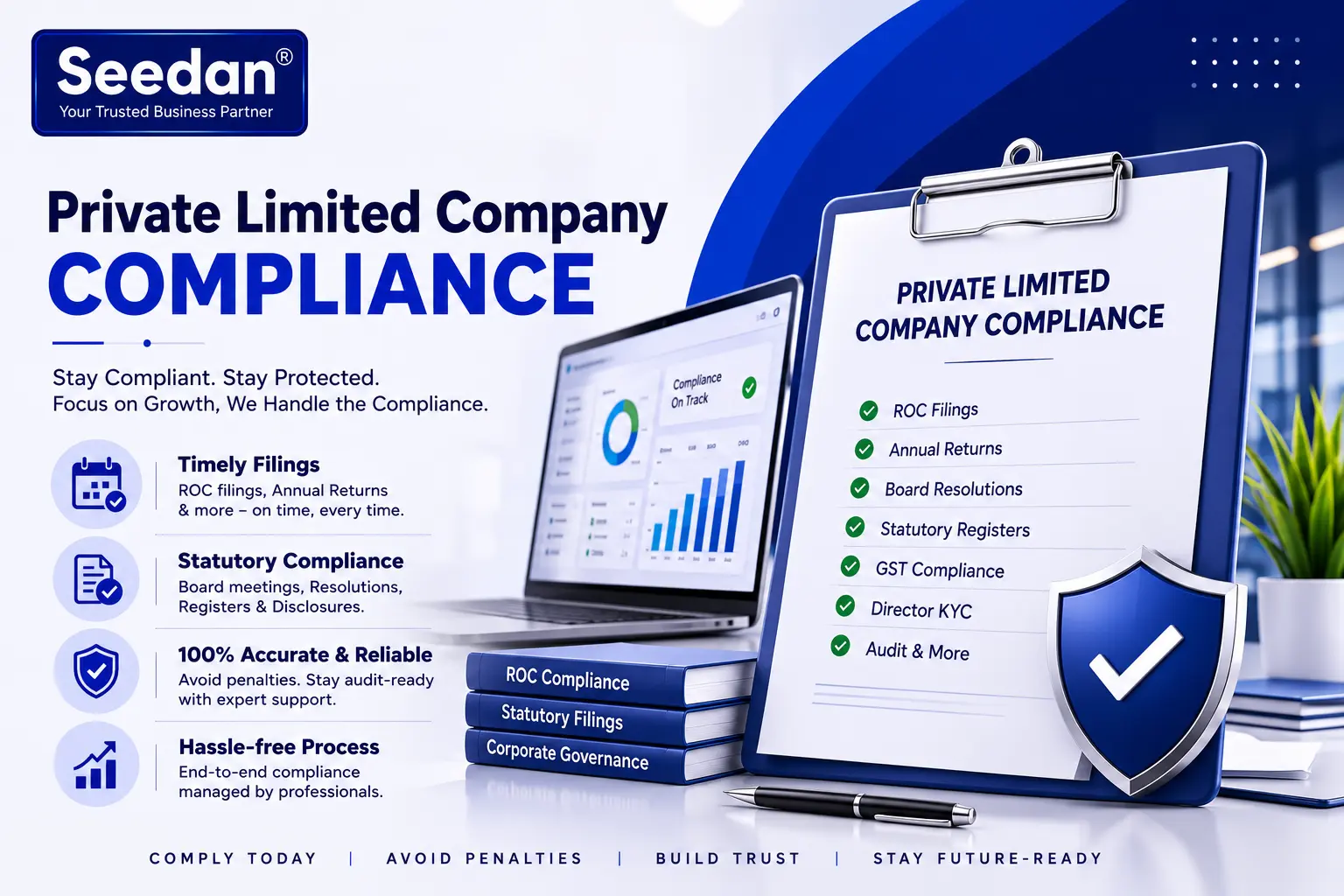
What Does Private Limited Company Compliance Cover?
A Private Limited Company carries the highest compliance burden among India's common business structures, since it's governed comprehensively by the Companies Act, 2013 — every company, regardless of turnover or profitability, must maintain audited financial statements, file annual returns with the Registrar of Companies, hold a minimum number of board meetings, and maintain statutory registers.
The two core ROC filings are Form AOC-4 (financial statements — balance sheet, profit & loss, and board's report) and Form MGT-7 (annual return — shareholding pattern, director details, and other corporate information). Both are filed annually, and both require the company's accounts to already be audited, since Form AOC-4 specifically requires the audited financial statements as an attachment.
Beyond ROC filings, the company must also file its income tax return (ITR-6), comply with GST if registered, and — for companies with employees — handle PF/ESI/Professional Tax obligations.
Private Limited Company Annual Compliance Checklist
Step-by-Step Process to Stay Compliant
- 1Maintain audited books of accounts throughout the year — this is mandatory for every Private Limited Company, unlike other entity types.
- 2Hold the required minimum board meetings (generally 4 per year, with gaps not exceeding 120 days between consecutive meetings).
- 3Conduct the Annual General Meeting (AGM) within 6 months of financial year-end.
- 4Complete the statutory audit, obtaining audited financial statements and the auditor's report.
- 5File Form AOC-4 within 30 days of the AGM, attaching audited financial statements.
- 6File Form MGT-7 within 60 days of the AGM, covering shareholding and director details.
- 7File the annual ITR-6, incorporating audited financials and MAT computation if applicable, along with any GST/TDS filings due through the year.
Private Limited Compliance vs Related Entity Compliance
Frequently Asked Questions
Yes, every Private Limited Company is required to have its accounts audited annually under the Companies Act, regardless of turnover, profitability, or business activity — this is one of the key differences from proprietorships, partnerships, and smaller LLPs, where audit is turnover-dependent.
Late filing of either form attracts a penalty that accrues per day of delay, with no upper cap in most cases, in addition to the company potentially being flagged as a defaulter by the Registrar of Companies for continued non-compliance.
A minimum of 4 board meetings per year is generally required, with the gap between two consecutive meetings not exceeding 120 days — small companies and OPCs have relaxed requirements, typically 2 meetings per year.
No, even a dormant company with zero business activity must complete the statutory audit and file AOC-4, MGT-7, and its income tax return annually — dormant status under the Companies Act is a separate formal filing, not an automatic exemption from these obligations.
Prolonged non-filing can result in the company being marked as a "defaulter," directors being disqualified from holding directorships in other companies, and eventually the company being struck off the Register of Companies by the ROC. ---
Ready for full Private Limited Company compliance support?
Statutory audit coordination, ROC filings & tax filing in one package.
⭐ 4.9/5 rated • CA/CS Assisted
Reviewed by our compliance team
CA/CS Panel, Seedan Group
This guide is reviewed by practicing Chartered Accountants and Company Secretaries at Seedan Group with hands-on experience in Indian business registration and compliance. Content is for general guidance and updated as regulations change.
Related Services
Other services our clients often pair with this one.
Bookkeeping & Accounting
Bookkeeping & Accounting Services cover the systematic recording, organizing, and reconciling of a business's financial transactions — sales, purchases, expen
Learn moreBusiness Plan Preparation
A Business Plan is a structured document outlining a business's objectives, market analysis, operational model, and financial projections — required for bank
Learn moreESI Return Filing
ESI Return Filing is the monthly submission of employee contribution details to the ESIC, reporting wages and the corresponding ESI contribution (employer and
Learn moreFSSAI Renewal
FSSAI Renewal is the process of extending an existing FSSAI Registration or License before its validity period expires, required to avoid disruption to food b
Learn more