
HR & Payroll Management in India
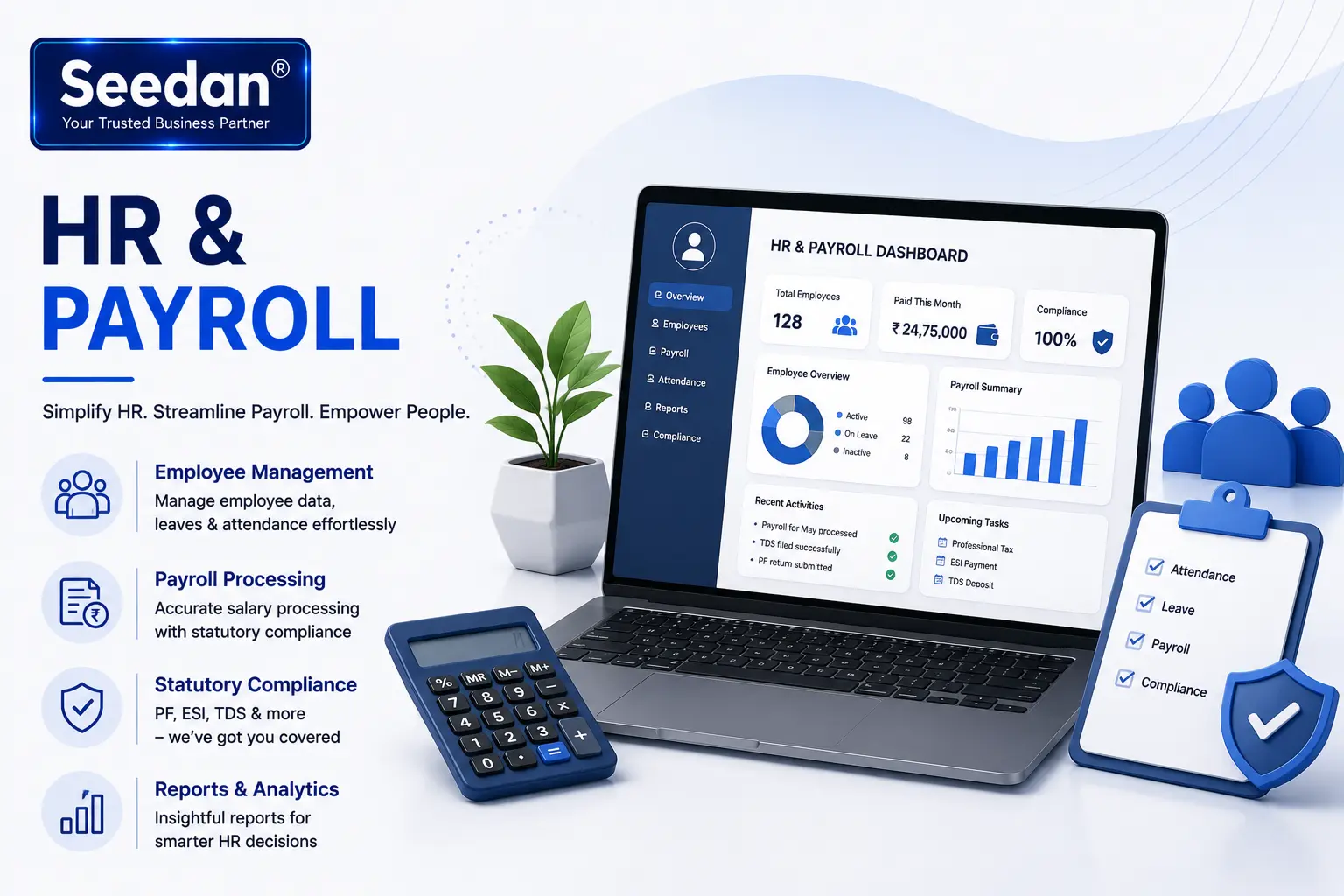
HR & Payroll Management covers the end-to-end processing of employee salaries, statutory deductions (PF, ESI, Professional Tax, TDS), compliance filings, and core HR functions like onboarding, leave management, and exit formalities. For growing businesses, outsourcing this reduces compliance risk across multiple overlapping laws (EPF Act, ESI Act, Income Tax Act, state Shops & Establishment Acts).
What Is HR & Payroll Management?
HR & Payroll Management combines two closely linked functions: payroll processing — calculating salaries, statutory deductions, and net pay each month — and HR administration — managing employee lifecycle events like onboarding, attendance, leave, and exit. For a business with employees, both functions carry significant compliance weight, since payroll errors ripple into PF, ESI, Professional Tax, and TDS filings, each governed by a different law with its own deadlines and penalties.
As a business grows past its first few employees, manually managing this across spreadsheets becomes error-prone and time-consuming — most growing businesses either invest in payroll software or outsource the function entirely to ensure statutory deductions are calculated correctly and filed on time every month.
What HR & Payroll Management Should Cover
Step-by-Step Process to Set Up Payroll Management
- 1Assess employee headcount and applicable compliance obligations — PF (20+ employees), ESI (10+ in most states), Professional Tax (state-dependent).
- 2Choose an approach — in-house payroll software, or an outsourced payroll management service.
- 3Set up employee master data — salary structure, bank details, PF/ESI enrollment, tax declarations.
- 4Configure statutory deduction rules per applicable thresholds and rates.
- 5Run monthly payroll — compute salaries, deductions, and generate payslips.
- 6File statutory returns (PF, ESI, TDS, Professional Tax) based on payroll data, per each law's deadline.
- 7Handle ongoing HR events — new hires, exits, leave, and any statutory registration updates as headcount changes.
HR & Payroll vs Related Employee Compliance Services
Frequently Asked Questions
Many small businesses start outsourcing once they cross a handful of employees, since that's typically when statutory compliance (PF, ESI, Professional Tax) becomes mandatory and the risk of manual calculation errors and missed deadlines increases significantly.
Payroll touches PF (mandatory at 20+ employees), ESI (mandatory at 10+ employees in most states), Professional Tax (state-dependent), and TDS on salary (Section 192) — each with its own calculation rules, deposit deadlines, and return filing requirements.
Yes, comprehensive HR & Payroll services typically extend beyond salary processing to cover the full employee lifecycle — onboarding documentation, leave and attendance tracking, and exit formalities including full and final settlement calculations.
Errors or delays in statutory payroll filings can result in interest, penalties, and — in the case of PF/ESI specifically — can affect employees' ability to access their benefits, making accuracy and timeliness particularly important in this area.
Payroll software can handle calculation and payslip generation well for straightforward cases, but a full-service provider adds value through compliance filing, staying current with rate/rule changes, and handling exceptions (like mid-month joiners, exits, or multi-state employees) that software alone doesn't resolve. ---
Ready to outsource your HR & Payroll?
Full payroll processing & compliance filing.
⭐ 4.9/5 rated • CA/CS Assisted
Reviewed by our compliance team
CA/CS Panel, Seedan Group
This guide is reviewed by practicing Chartered Accountants and Company Secretaries at Seedan Group with hands-on experience in Indian business registration and compliance. Content is for general guidance and updated as regulations change.
Related Services
Other services our clients often pair with this one.
Bookkeeping & Accounting
Bookkeeping & Accounting Services cover the systematic recording, organizing, and reconciling of a business's financial transactions — sales, purchases, expen
Learn moreBusiness Plan Preparation
A Business Plan is a structured document outlining a business's objectives, market analysis, operational model, and financial projections — required for bank
Learn moreESI Return Filing
ESI Return Filing is the monthly submission of employee contribution details to the ESIC, reporting wages and the corresponding ESI contribution (employer and
Learn moreFSSAI Renewal
FSSAI Renewal is the process of extending an existing FSSAI Registration or License before its validity period expires, required to avoid disruption to food b
Learn more